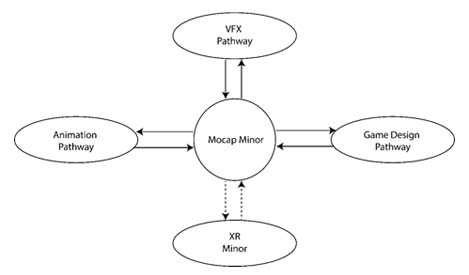
A Pedagogical Workflow for Interconnected Learning: Integrating Motion Capture in Animation, Visual Effects, and Game Design: Major/Minor curriculum structure that supports the integration of Motion Capture with Animation, Visual Effects and Game Design T
Researchers: Hossein Najafi, Jason Kennedy, Emily Ramsay, Masaya Todoroki, Gregory Bennett
This paper presents a case study in a curriculum structure that aims to integrate specialised course content across a range of primary study pathways. The 3-year Bachelor of Design degree at the School of Art and Design, Auckland University of Technology, New Zealand, offers a major in animation, visual effects and game design in which students can follow specialised pathways of study in these three areas. In addition to their selected major, students can select two minors to support their major course of study. A popular choice is the motion capture minor that has strong technical and creative relevance to all three study pathways and, due to time and scope restraints, is not able to be covered directly in the curriculum content of the majors. This paper examines this major/minor structure as a useful interconnected curriculum framework that supports a learning environment whereby students can gain both in-depth creative and technical expertise in a specialised and future-focused creative technology but also bring that knowledge to their major pathways of study.